


Where Are Online Sweepstakes Casinos Legal in the U.S.
Sweepstakes casinos offer casino-like games under promotional laws, making them legal in many U.S. states. Although broadly legal due to the ‘no purchase necessary’ rule, the exact status varies significantly between states. SweepsChaser provides a detailed overview of the state-by-state legality of sweepstakes casinos, highlighting jurisdictions with specific restrictions, outright bans, or unique regulatory considerations.
Legal in Most States
While sweepstakes casinos are legal in most states, operators often choose not to serve every location due to their interpretation of local regulations or potential legal risks. For instance, Fortune Coins currently operates legally in 47 states and Washington D.C., excluding 3 states. Players should always review an individual platform’s terms and their state-specific regulations before participating.
» Want to know if a specific sweepstakes casino is allowed in your state? Take a look at our full list of sweepstakes casinos in the US and their respective reviews.
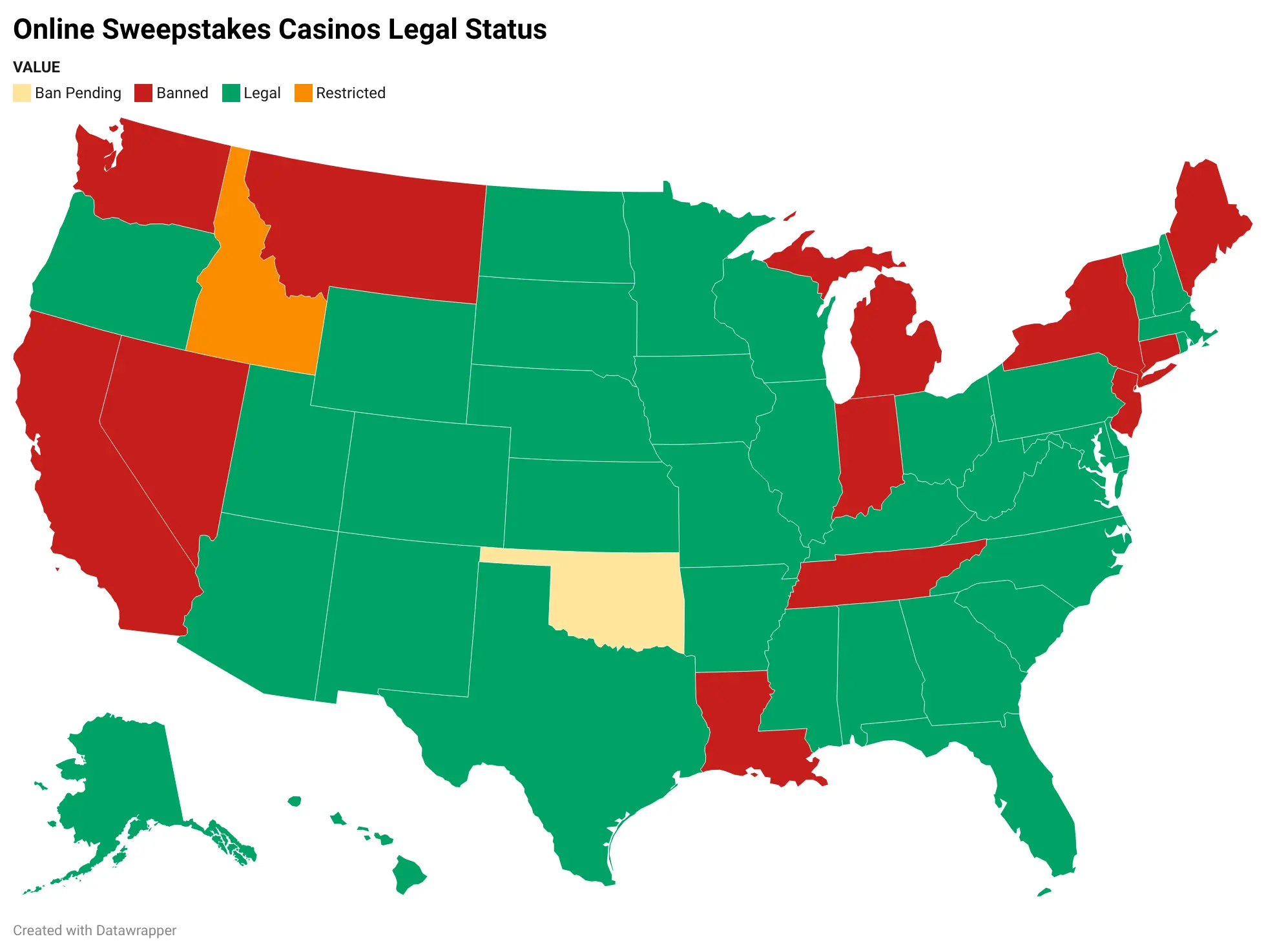
- Legal – Sweepstakes Casinos are legal
- Banned – Sweepstakes Casinos are banned
- Ban Pending – Legislation banning sweepstakes casinos has passed but hasn’t come into effect yet.
- Under Review – Sweepstakes Casino legislation is pending or hasn’t come into effect yet
- Restricted – Sweepstakes Casinos are limited in some way (offering only gold coins play)
Why Sweepstakes Casinos Are So Widely Available
While there are superficial similarities between various types of online iGaming, the U.S. landscape includes three distinct models: regulated real-money casinos, sweepstakes-based platforms, and purely social casino games.
Three Models, Three Sets of Rules
Most Americans don’t live in a state where real-money online casinos are legal. These platforms require full gambling licenses and are fenced to specific states like New Jersey, Michigan, and Pennsylvania. Access is restricted using geolocation, and players must verify their identity before making deposits or cashing out. Everything from the games offered to the payment methods used is regulated.
» The offshore platforms behind login systems like Inclave sit outside this framework entirely. We explain why, and what to play instead, in our guide to Inclave casinos and their legal alternatives.
Sweepstakes casinos take a different route. They don’t require gambling licenses because they aren’t technically gambling sites. Players use virtual currencies: some for entertainment (Gold Coins) and others for potential redemption (Sweeps Coins). As long as players can participate without paying, these platforms remain legal under sweepstakes laws. That’s why you’ll find them operating in nearly every state, aside from a few like Washington and Idaho where the model has been directly challenged. Sweepstakes sportsbooks or social sportsbooks also function under this model.
Then there are social casinos. They are apps and websites that offer casino-style games purely for fun. Nothing players earn or win can be turned into cash or prizes. Because no value is exchanged or at risk, they aren’t subject to gambling rules at all. Some sweepstakes casinos operate in states where they’d normally be restricted or banned by simply cutting the currency that can be redeemed from their offer, effectively operating as social casinos.
What It Means for Players
The regulatory differences shape how and where players can access each type of casino.
Real-money platforms are confined to a small group of states and require players to be physically located within those borders. That limits their audience, but also means players benefit from strict oversight and high-quality, licensed content.
Sweepstakes casinos offer a middle ground: widely accessible, legal in most of the U.S., and with a chance to redeem virtual currency for real-world prizes. They fill the gap for players in states without regulated gambling options, offering slots, keno, and even fish games with minimal friction.
Social casinos are the most casual option of all. They’re designed for pure entertainment, available anywhere, and usually include features like daily rewards or themed events—but there’s no way to convert progress into money.
Cashing In (Or Not)
How money flows through these platforms is another point of contrast.
Licensed online casinos accept real-money deposits and process withdrawals through familiar channels like bank transfers, cards, and e-wallets. Transactions are fast but monitored, often requiring ID verification and compliance with anti-money laundering rules.
Sweepstakes casinos don’t accept gambling deposits. Instead, players buy coin bundles that may include bonus Sweeps Coins. Once players earn enough SC—usually between 50 and 100—they can redeem them for cash or gift cards after verifying their identity.
Social casinos don’t offer any redemptions at all. Any money spent goes toward virtual currency to keep playing, and all rewards are digital or cosmetic.
Quick Breakdown: What Makes Each Model Unique
| Information | Real-Money Casinos | Sweepstakes Casinos | Social Casinos |
|---|---|---|---|
| Where They’re Legal | 6 states | Most states | All 50 states |
| Licensing | Required | Not needed (sweepstakes model) | Not required |
| Playable Currency | USD | Gold Coins & Sweeps Coins | Virtual coins |
| Can You Win Cash? | Yes | Yes (via SC redemption) | No |
| Who Can Access | Players within licensed states | Anyone in eligible states | Anyone nationwide |
| Game Catalog | Premium slots, live dealers | Slots, keno, fish games | Casual and social-style games |
| Redemption Methods | Bank, card, e-wallet, ACH | SC redemption via bank/gift card | No redemptions |
States with Specific Restrictions or Bans
Several states have imposed explicit restrictions or outright bans on sweepstakes casinos:
Here is the updated and refined list reflecting the legal landscape as of October 2026. I have adjusted the statuses of several states where “pending” legislation has now officially become law, and added new jurisdictions that have since implemented bans.
States with Specific Restrictions or Bans (Updated October 2026)
Last verified: August 7, 2026
Eleven states have enacted laws targeting dual-currency sweepstakes casinos, and three more block them under pre-existing gambling statutes. Seven of the new bans are already in force; four are signed but not yet effective. A separate group of states has not banned the model but has armed regulators with cease-and-desist power or run active enforcement campaigns. The list below separates what is live from what is coming, with effective dates treated as the operative fact.
Bans in force
Play is prohibited in these states today. Most major operators have already exited.
| State | Law | In force | Penalty |
|---|---|---|---|
| California | AB 831 | Jan 1, 2026 | Misdemeanor; $1,000–$25,000 and/or up to 1 year county jail |
| Connecticut | SB 1235 (PA 25-112) | Oct 1, 2025 | Class D felony (up to 5 years / $5,000) |
| Montana | SB 555 | Oct 1, 2025 | Up to 10 years / $50,000 |
| Nevada | SB 256 | Oct 1, 2025 | Category B felony; profit disgorgement; extraterritorial reach |
| New Jersey | A5447 | Aug 15, 2025 | Up to $25,000 per violation |
| New York | S5935A | Dec 5, 2025 (immediate) | $10,000–$100,000 per violation |
| Tennessee | SB 2136 / HB 1885 | May 22, 2026 (immediate) | $5,000–$15,000 per violation; private right of action |
| Indiana | HB 1052 | July 1, 2026 | Civil, up to $100,000 |
| Maine | LD 2007 | July 15, 2026 | Civil, $10,000–$100,000 |
| Louisiana | HB 883 + HB 53 | Aug 1, 2026 | Illegal “gambling by computer” + racketeering predicate (up to 50 years at hard labor / $1M) |
Enacted, not yet in effect
These bans are signed law but have a future effective date. Sweepstakes play may still be available in-state until the date listed; verify operator availability as each date passes.
State | Law | Effective | Penalty |
|---|---|---|---|
| Oklahoma | SB 1589 (veto override) | Nov 1, 2026 | Class C2 felony |
Effective bans under pre-existing law
No new 2025–2026 statute, but sweepstakes casinos are blocked under existing gambling law or the state constitution. Reputable operators run Gold Coin–only play or block these states outright.
- Washington – online gambling is a Class C felony under RCW 9.46.240; historically the only state to target players as well as operators.
- Michigan – the Michigan Gaming Control Board enforces against unlicensed dual-currency platforms under the Lawful Internet Gaming Act.
- Idaho – the state constitution’s gambling prohibition restricts play to Gold Coin / no-redemption mode.
Enforcement power granted — no direct ban
These states have not banned the dual-currency model, but regulators now hold or have used cease-and-desist authority. Access can disappear quickly and without further legislation.
- Iowa – SF 2289, signed May 15, 2026, gives the Iowa Racing and Gaming Commission cease-and-desist and injunctive authority over unlicensed operators effective July 1, 2026. Not a dual-currency ban; play remains available in-state until enforcement begins, and the IRGC has not named targets.
- Illinois – the Illinois Gaming Board, with AG Kwame Raoul, issued 65 cease-and-desist letters in February 2026; SB 1705 is pending.
- Maryland – the Lottery and Gaming Control Agency has issued C&D letters; ban bills (HB 295 / HB 1226) died in the Senate as the session ended April 13, 2026.
- Mississippi – the Gaming Commission issued C&D letters in April 2026; SB 2104 died.
- Minnesota – the AG issued C&D letters; SF 4474 passed the Senate but died in the House.
- Active cease-and-desist activity also reported in Delaware, West Virginia and Pennsylvania.
2026 ban bills that failed
Sweepstakes casinos remain legal in these states after ban legislation stalled this session. Several efforts are expected to return in 2027.
Florida (HB 189 / SB 1580 / HB 591), Virginia (HB 161), Massachusetts (HB 4431), Mississippi (SB 2104), Maryland (HB 295 / HB 1226), Minnesota (SF 4474), Hawaii (SB 3281) and Ohio (HB 298, stalled).
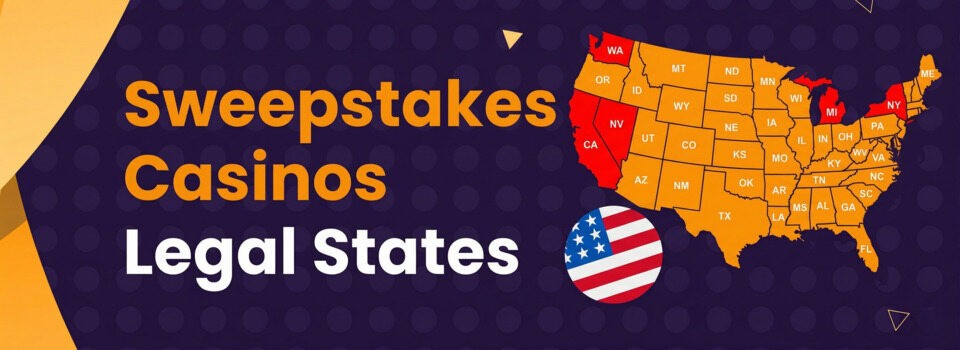
Legal Status of Sweepstakes Casinos in all US States
| State | Availability | Notes/Exceptions |
|---|---|---|
| Alabama | Legal | Generally legal under promotional laws |
| Alaska | Legal | Generally legal under promotional laws |
| Arizona | Legal | Generally legal under promotional laws |
| Arkansas | Legal | Pending ban with legalization of iGaming. Legislation (SB 524/HB 1861) under review to target unlicensed operators |
| California | Banned | AB 831 banned sweepstakes on January 1, 2026 |
| Colorado | Legal | Generally legal under promotional laws |
| Connecticut | Banned | SB 1235, signed into law on June 16, 2025, reclassifies them as a Class D felony; ban effective October 1, 2025 |
| Delaware | Restricted | Regulatory enforcement is in effect; multiple operators have received cease-and-desist letters |
| District of Columbia | Legal | Requires charitable gaming licenses for some activities |
| Florida | Legal | 2026 ban failed |
| Georgia | Legal | Generally legal under promotional laws |
| Hawaii | Legal | Generally legal under promotional laws |
| Idaho | Restricted (Gold Coins only) | Real-money redemption is prohibited; sweeps coins cannot be redeemed for cash |
| Illinois | Legal | Generally legal under promotional laws |
| Indiana | Banned | Ban effective as of July 2026 |
| Iowa | Enforcement statute enacted | No direct ban; play still available, regulator gains C&D power July 1, 2026 |
| Kansas | Legal | Generally legal under promotional laws |
| Kentucky | Legal | Generally legal under promotional laws |
| Louisiana | Banned | Effective as of August 1, 2026 |
| Maine | Banned | Effective as of July 2026 |
| Maryland | Legal | Regulatory oversight is in effect; at least 12 cease-and-desist letters issued. Legislative ban (SB 860) failed to pass |
| Massachusetts | Legal | Generally legal under promotional laws |
| Michigan | Banned | Regulatory enforcement is in effect; operators have received cease-and-desist letters |
| Minnesota | Legal | Generally legal under promotional laws |
| Mississippi | Legal | Recently rejected bans; generally legal |
| Missouri | Legal | Generally legal under promotional laws |
| Montana | Banned | SB 555 bans platforms effective Oct 2025 |
| Nebraska | Legal | Generally legal under promotional laws |
| Nevada | Banned | SB 256 and Gaming Board actions have effectively ended the sweepstakes model |
| New Hampshire | Legal | Generally legal under promotional laws |
| New Jersey | Banned | Sweepstakes banned underA5447/S4282 |
| New Mexico | Legal | Generally legal under promotional laws |
| New York | Banned | S5935A banned sweepstakes as of January 1, 2026. |
| North Carolina | Legal | Generally legal under promotional laws |
| North Dakota | Legal | Generally legal under promotional laws |
| Ohio | Under Review | House Bill 298 proposes restrictions |
| Oklahoma | Ban pending | Legal ban will come in effect on November 1, 2026 |
| Oregon | Legal | Generally legal under promotional laws |
| Pennsylvania | Legal | Regulatory enforcement is active, with 18 cease-and-desist letters issued. Legislative modernization is proposed. |
| Rhode Island | Legal | Registration required for larger prizes |
| South Carolina | Legal | Generally legal under promotional laws |
| South Dakota | Legal | Generally legal under promotional laws |
| Tennessee | Banned | Bill signed May 22, 2026 |
| Texas | Legal | Generally legal under promotional laws |
| Utah | Legal | Generally legal under promotional laws |
| Vermont | Restricted | No purchase or entry fee allowed |
| Virginia | Legal | Generally legal under promotional laws |
| Washington | Banned | Explicitly banned |
| West Virginia | Legal | Enforcement actions noted; generally legal |
| Wisconsin | Legal | Generally legal under promotional laws |
| Wyoming | Legal | Generally legal under promotional laws |
Sweepstakes Casino Legal Changes Tracker (Updated, October 2026)
We check every state status against enacted bills and live operator pages before each update.
Upcoming effective dates
These bans are signed law but not yet in force. Play may still be available in-state until the date listed.
- November 1, 2026 – Oklahoma’s ban (SB 1589) takes effect.
Recent updates
- July 1, 2026 – Indiana’s ban (HB 1052) takes effect. Iowa regulators also gain cease-and-desist authority over unlicensed operators (SF 2289).
- Mid-July 2026 – Maine’s ban (LD 2007) takes effect.
- August 1, 2026 – Louisiana’s bans (HB 883, HB 53) take effect, including racketeering exposure.
- June 1, 2026 – Minnesota’s ban bill (SF 4474) dies as the session ends. It cleared the Senate but stalled in the House. Sweepstakes remain legal.
- May 22, 2026 – Tennessee bans dual-currency sweepstakes (SB 2136 / HB 1885), effective immediately. Penalties run $5,000–$15,000 per violation, with a private right of action.
- Late May 2026 – Louisiana enacts HB 883 and HB 53, treating dual-currency play as illegal gambling by computer and adding it as a racketeering predicate. Both take effect August 1, 2026.
- May 15, 2026 – Iowa grants the Racing and Gaming Commission cease-and-desist and injunctive authority over unlicensed operators (SF 2289), effective July 1, 2026. It is not a direct ban; play remains available until then.
- May 14–15, 2026 – Oklahoma overrides Gov. Kevin Stitt’s veto of SB 1589 (Senate 34-10, House 68-19). The ban takes effect November 1, 2026 and names promoters and affiliate partners.
- April 13, 2026 – Maryland’s ban bills (HB 295, HB 1226) die as the session ends. They passed the House but stalled in the Senate.
- April 6, 2026 – Maine bans dual-currency sweepstakes (LD 2007), effective mid-July 2026.
- March 12, 2026 – Indiana bans sweepstakes casinos (HB 1052), effective July 1, 2026.
- February 5, 2026 – Illinois regulators and the Attorney General issue 65 cease-and-desist letters to operators. SB 1705 remains pending.
- Spring 2026 – Florida’s ban bills (HB 189, SB 1580, HB 591) die. Sweepstakes remain legal under existing state law.
- January 1, 2026 – California’s ban (AB 831) takes effect. Major operators exit the state.
- December 5, 2025 – New York bans sweepstakes (S5935A), effective immediately. The law names media affiliates.
- October 11, 2025 – California enacts AB 831, scheduling a ban for January 1, 2026.
- October 1, 2025 – Bans take effect in Montana, Connecticut and Nevada.
- August 15, 2025 – New Jersey bans dual-currency sweepstakes (A5447), criminalizing promotion.
- June 12, 2025 – Connecticut enacts SB 1235 (Public Act 25-112), banning sweepstakes and their promotion.
- May 12, 2025 – Montana enacts the first explicit state ban (SB 555).
The “Clean-Up” of the Dual-Currency Model
Following the California and New York bans, many reputable operators have pivoted. In restricted states, you will now see:
- Gold Coin Only Access: You can play for fun, but the “Sweeps Coin” toggle is completely disabled.
- Stricter KYC (Know Your Customer): In 2026, most platforms require ID verification before you can even claim a daily bonus, not just at redemption.
Increased Pressure from Tribal Gaming
In states like California and Florida, the push for bans has been heavily funded and supported by Tribal Gaming Associations. These groups view sweepstakes casinos as unregulated competition that bypasses the tribal-state compacts.
The “New Jersey Model” of Enforcement
New Jersey’s 2025 ban was significant because it didn’t just target the casino sites; it targeted the “supporting infrastructure.” In 2026, payment processors (like credit card companies) and geolocation providers are increasingly blocking transactions for sweepstakes sites in prohibited states to avoid “aiding and abetting” penalties.
Rise of State-Level Cease-and-Desist Letters
Even without new laws, Attorneys General in Michigan, Delaware, and West Virginia have set a 2026 precedent of using existing consumer protection laws to issue mass cease-and-desist orders. This has created a “patchwork” where a site might be legal in the morning and blocked by the afternoon.
Sweepstakes Casino Legal Landscape FAQ
Are sweepstakes casinos legal?

Yes, in most U.S. states because they operate under sweepstakes laws and adhere to the “no purchase necessary” principle, avoiding direct real-money wagering. However, legality varies by state, with some states having explicit restrictions or bans.
Are Sweepstakes Casinos legal in New Jersey?
No. Sweepstakes casinos are banned in New Jersey under A5447, signed Aug 15, 2025; promotion is also prohibited and can reach affiliates.
Which states ban or restrict sweepstakes casinos?
States that currently restrict or ban sweepstakes casinos include California, New Jersey, Indiana, Maine, Oklahoma, Washington, Idaho, Michigan, Montana, Connecticut, New York, Kentucky, Louisiana, Nevada, Tennessee, Alabama, Georgia, and Vermont. Some only restrict real-money-style redemptions, while others prohibit the platforms entirely.
How do sweepstakes casinos avoid gambling laws?
They use a promotional sweepstakes model with no purchase required. Players can earn or receive “Sweeps Coins” through free methods (like mail-in entries or social promos), which can then be redeemed for real prizes. Because there’s no mandatory payment, they sidestep most gambling regulations.
What is the “No Purchase Necessary” (NPN) rule?
This rule means players must be able to enter and play without spending money. All legitimate sweepstakes casinos offer a free entry option—known as an Alternate Method of Entry (AMOE)—which keeps them compliant with sweepstakes laws.
Are sweepstakes casino winnings taxable?
Yes. Just like lottery prizes or gambling winnings, cash or gift card redemptions from sweepstakes casinos may be considered taxable income. Players should keep records and consult a tax professional if unsure.
Can I play sweepstakes casinos from anywhere in the U.S.?
Almost. Most platforms are available nationwide, but each operator maintains its own list of excluded states based on risk or regulatory interpretation. Always check a casino’s terms and conditions to confirm availability in your state.